
Vintage Jacket Relining – Restoring a Classic Rider’s Via Cosmos Jacket

Giving a Vintage Jacket a New Lease of Life
Some garments deserve far more than a simple repair. Whether it’s their distinctive design, sentimental value or the quality of their original construction, certain pieces are worth preserving. At my Tailor-Alter studio in Sutton, South London, I recently undertook a complete vintage jacket relining and restoration project on a striking red Rider’s Via Cosmos jacket featuring San Diego branding.
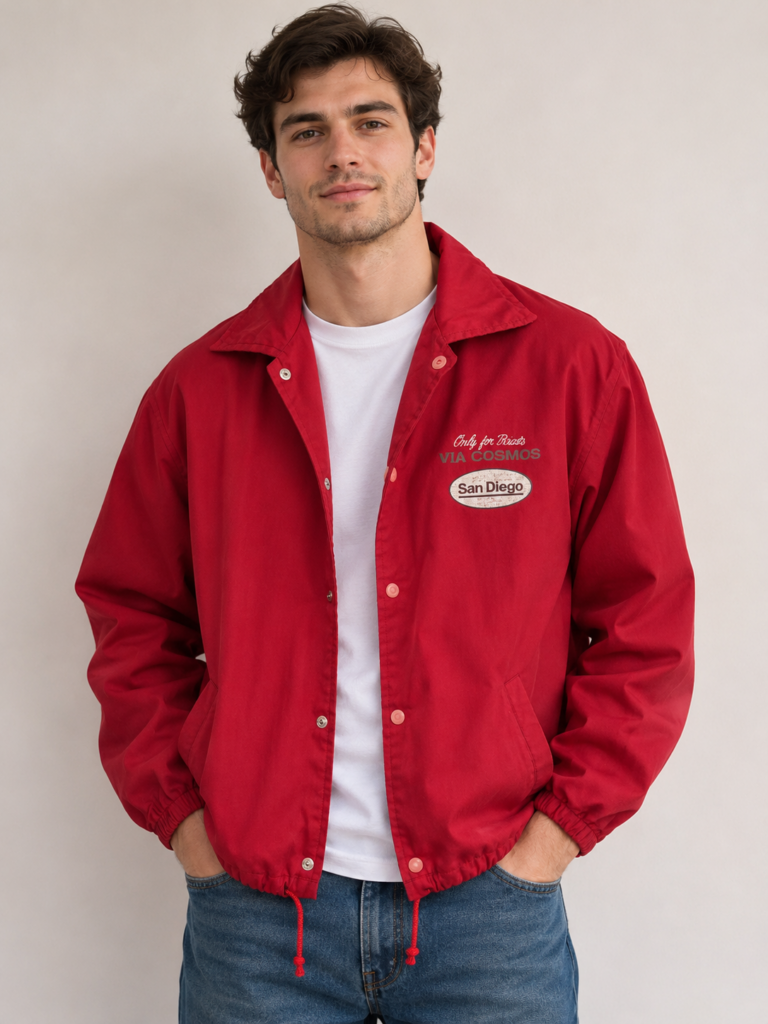
The jacket’s vibrant red exterior, original detailing and distinctive design made it a piece worth keeping. However, its internal lining required replacement, making this a much more involved project than a straightforward alteration.
The work included recreating the body and sleeve linings, reconstructing the internal pocket bags and carefully integrating the new components into the existing jacket while preserving its original character.
Vintage Jacket Relining | Understanding the Original Jacket Construction
Before beginning any restoration, I believe it’s important to understand how a garment was originally made.
Unlike constructing something new, working with an existing garment requires careful consideration of its original shape, seam allowances, internal finishing and construction methods.
This red Rider’s Via Cosmos jacket featured several distinctive details:
- A relaxed, casual silhouette with a front snap-button fastening.
- A contrasting white internal lining.
- A branded neckline label and embroidered chest detailing.
- Functional pockets integrated into the outer shell.
- A gathered lower edge with drawcord detailing.
- Original stitching and finishing that needed to be respected throughout the restoration.
The aim was not to redesign the jacket, but to renew its interior while retaining the characteristics that made it distinctive.
Removing the Old Lining and Examining the Construction
The first stage of the vintage jacket relining process involved examining the existing lining and the way it was attached to the outer shell.

The original lining provided valuable information about the jacket’s internal structure. Each section needed to be considered in relation to the outer garment, including how the lining fitted around the neckline, front openings, armholes and hem.
Particular attention was necessary around the pockets, where the lining and pocket-bag construction interacted with the red outer fabric.
One of the challenges with restoration work is ensuring that new components fit an existing garment correctly without pulling, restricting movement or distorting its silhouette.
This requires a different approach from simply following a commercial sewing pattern.
Drafting New Lining Patterns
Recreating the Front, Back and Sleeve Pieces
One of the most important parts of this project was developing the lining patterns.
Using pattern paper, I prepared separate pieces for the front, back and sleeves, taking into account the jacket’s existing proportions and construction.

The photographs of this stage show the individual pattern pieces laid out before cutting, including the shaping around the armholes and sleeve heads.
A jacket lining must do more than fit inside the outer shell. It needs sufficient ease to allow the wearer to move comfortably, particularly across the shoulders and back.
Care must also be taken to ensure the sleeves hang correctly and that the lining does not pull against the outer fabric.
The relationship between the outer jacket and its lining is especially important in a relaxed garment such as this, where the original drape and ease are part of the design.
This stage of vintage jacket relining demonstrates why accurate pattern cutting is an essential part of professional garment restoration.
Reconstructing the Pocket Bags
More Than Just Replacing the Lining
An important part of this restoration was the complete reconstruction of the jacket’s internal pocket bags.
Pocket bags are often hidden from view, yet they are essential to a garment’s functionality.
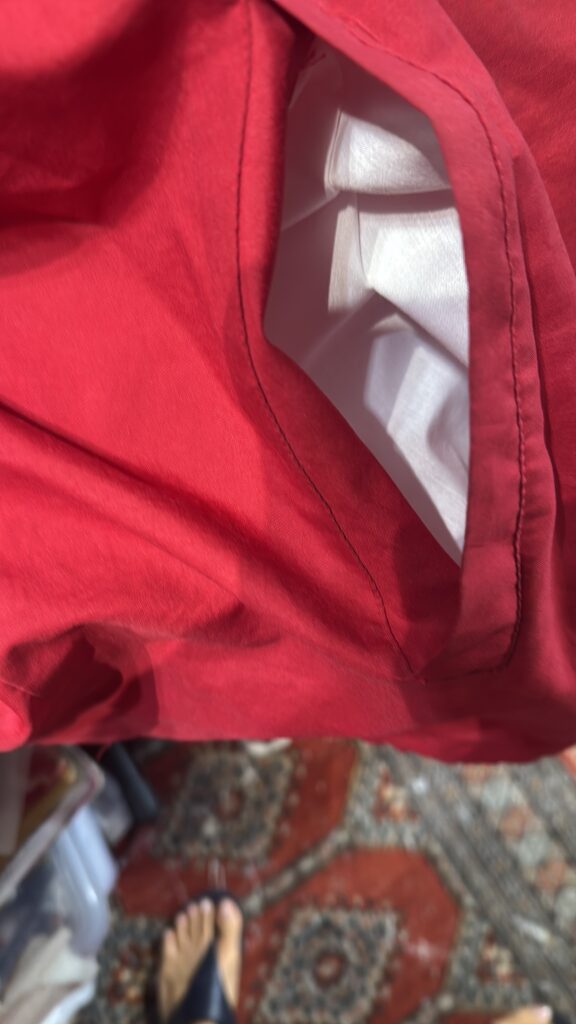
They must be correctly shaped, securely attached and positioned so that they sit comfortably inside the jacket without creating unnecessary bulk.
The original pocket sections were examined, and replacement pieces were prepared to work with the existing pocket openings.
The photographs show the original pocket-bag construction and the individual fabric pieces used during the restoration.
Working around an existing pocket opening requires care, particularly when the aim is to preserve the outer fabric and visible stitching.
The finished pocket bags needed to remain functional while integrating neatly with the replacement lining.
Although this work is largely invisible from the outside, it represents an important part of a thorough and considered restoration.
Choosing and Preparing the New Lining
For this jacket, a light-coloured woven lining was used to retain the contrast between the red exterior and the original white interior.
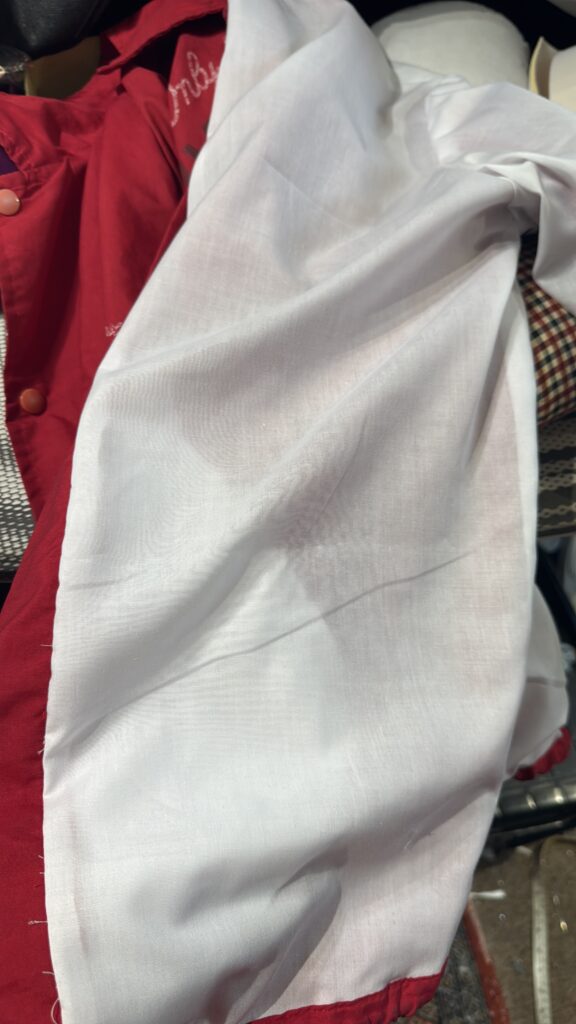
The replacement fabric needed to work with the jacket’s relaxed construction while providing sufficient comfort and movement.
Once the lining patterns were prepared, the pieces were laid out and cut, taking care to follow the appropriate grainlines.
Correct grain placement helps the lining hang naturally within the jacket and reduces unwanted twisting or distortion.
The fabric pieces were then prepared for assembly, with particular attention to their relationship with the jacket’s original seams and internal openings.
Rebuilding the Interior of the Jacket
With the new lining pieces prepared, the next stage was assembling and fitting the interior.
The body lining and sleeves needed to work together as a complete structure.
Careful fitting was particularly important around the shoulder and armhole areas, where even small inaccuracies can affect comfort and movement.
The new lining also needed to sit neatly behind the front fastening, beneath the collar and along the lower edge without interfering with the existing jacket construction.
The pocket bags were incorporated into the restoration, ensuring that the pockets remained usable.
Throughout the process, the intention was to preserve the exterior design rather than introduce unnecessary changes.
This is one of the aspects I find particularly satisfying about garment restoration: the finished result should feel natural, as though the renewed interior has always belonged to the garment.
Vintage Jacket Relining | Preserving the Original Details
The red outer shell is what gives this jacket its personality.
Its Rider’s Via Cosmos label, San Diego emblem, embroidered lettering, snap fastenings and original drawcord details all contribute to its distinctive appearance.
These features were important to preserve during the restoration.
A successful vintage jacket relining project should improve the garment’s internal condition without unnecessarily changing its outward identity.

The craftsmanship lies not only in what has been replaced, but also in what has been carefully retained.
Rather than discarding a garment because its lining has deteriorated, restoring the interior allows its original design to continue being appreciated.
Why Complete Jacket Relining Is a Specialist Alteration
Replacing a jacket lining can sometimes appear straightforward, particularly because much of the work is hidden.
In reality, a complete relining requires a combination of garment construction knowledge, pattern drafting, precise cutting and careful sewing.
When the original pocket bags also need reconstructing, the project becomes more involved.
It is necessary to understand how the different layers work together, how the lining is supported within the garment and how internal components can be replaced without compromising the outer shell.
This is why restoration projects are assessed individually.
The amount of work depends on the garment’s original construction, the condition of its fabric, the complexity of the lining and any additional internal repairs required.
For this Rider’s Via Cosmos jacket, the work went beyond cosmetic improvement. It involved rebuilding the internal fabric components to give the jacket a renewed, functional interior.
The Value of Repairing and Restoring Clothing
In a world where clothing is often replaced rather than repaired, I believe there is something particularly rewarding about preserving a well-loved garment.
Vintage clothing frequently carries details, construction methods and design characteristics that are difficult to find in modern garments.
Replacing worn linings, reconstructing pockets and restoring internal components can help extend the useful life of clothing while maintaining its individuality.
Not every garment needs to be completely redesigned to be given a new lease of life.
Sometimes the greatest transformation happens on the inside.
Professional Jacket Relining and Garment Restoration in Sutton
At Tailor-Alter in Sutton, South London, my work extends beyond wedding dress alterations to include specialist tailoring, garment reconstruction, repairs and restoration.
Projects like this vintage Rider’s Via Cosmos jacket allow me to combine traditional sewing techniques with pattern cutting and practical problem-solving.
Whether a garment requires a replacement lining, reconstructed pockets or more extensive alterations, I approach each piece with consideration for its original construction and character.
If you have a favourite jacket or treasured garment that needs attention, you’re welcome to get in touch to discuss the possibilities.
Tailor-Alter – Specialist Alterations, Jacket Relining and Garment Restoration in Sutton, South London.
Trusted Since 2003
For more than two decades, brides, grooms and their families have trusted me with their most important garments.
With over hundreds of ✨ 5* reviews on Google, I am recognised throughout Sutton, Cheam, Surrey and South London for specialist bridal, couture and occasionwear alterations, including complex fitting challenges, structural reshaping and precision finishing.
Reviews & Client Experiences
Read the experiences of brides, mothers of the bride, mothers of the groom and wedding party clients preserved in their own words on our Testimonials page.
Alongside published reviews, I have retained more than a decade of personal messages, cards and handwritten thank-you notes from clients, reflecting the care, expertise and craftsmanship invested into every garment.
Read our brides’ & wedding party clients experiences preserved in their own words since 2012 on the testimonial page →
Many of my clients travel considerable distances following recommendations from previous brides, boutiques and wedding professionals.
Appointments & Fittings
My diary is open for prebooking fittings .
📞07952561923
For consultation & booking fittings there is a deposit of £20 has to be paid in advance. This will get credited towards alterations costs, otherwise non refundable.
Please be punctual for your appointment slot and if you need to cancel minimum notice of 48 hours atleast has to be given. Click below to request a fitting